HidroVortex — Hydrodynamic sediment separator.
DN 800 and DN 1000. Treatment flow from 30 to 60 l/s. Protects drainage networks and SuDS basins from clogging.
The HidroVortex is a hydrodynamic sediment separator in HDPE, for underground installation. Runoff enters tangentially and forms a stabilised vortex: the denser particles settle in a bottom sludge chamber, hydraulically separated from the treatment chamber, while debris, oils and microplastics are held at the surface. Treated water leaves by gravity through the outer ring, with no resuspension of the sludge at peak flow. Two models, DN 800 and DN 1000, for 1.200 and 2.400 m² of connected area.
Why the HidroVortex?
Rainwater running off roads, car parks and roofs carries sand, debris and particles that clog infiltration basins, attenuation crates and sewers. A clogged basin loses capacity and is hard to clean — often it has to be dug up. The HidroVortex captures that material upstream, at a single point that is accessible and easy to empty.
That is why the CIRIA SuDS Manual (C753) points to hydrodynamic separators as a way to reduce the maintenance of downstream components and to avoid disturbing them to remove silt. Installed ahead of a HidroCrate basin or the connection to the sewer, the HidroVortex becomes part of the treatment train, with no moving parts and no energy use.
The advantages of the HidroVortex at a glance:
Treatment and protection
- ✓Captures sediment, debris and floatables before the basin or the sewer
- ✓Separate sludge chamber — no resuspension at peak flow
- ✓Dedicated baffle for microplastic retention
- ✓Connected area defined for category II surfaces (DWA‑A 102)
Construction
- ✓HDPE hydrodynamic internals, no moving parts
- ✓Reinforced rotomoulded polyethylene chamber (SIST EN 13598‑2)
- ✓Spherical base with bedding support
- ✓Suitable for high groundwater, with anchoring
Installation and maintenance
- ✓Compact DN 800 or DN 1000 chamber — less excavation
- ✓Outlet angle from 67° to 293°, set when ordering
- ✓Cleaned by suction through the access opening
- ✓No energy use and no consumables
The HidroVortex in detail
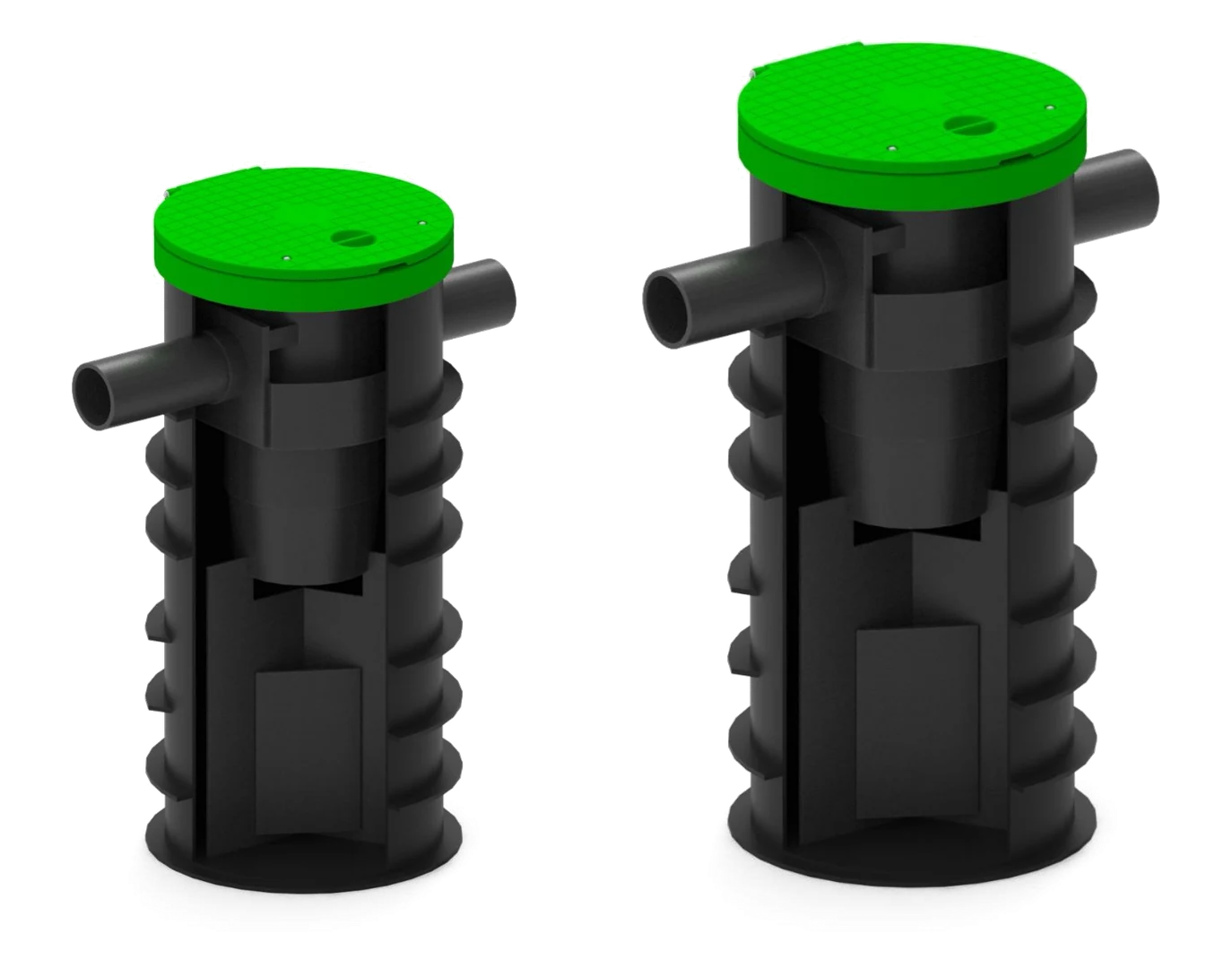
- 1Access openingDN 800 or DN 1000, for inspection and suction cleaning.
- 2Tangential inletFlow enters at a tangent to the chamber and creates the stabilised vortex.
- 3Treatment chamberThe spiral path increases residence time and helps particles settle.
- 4Microplastic baffleHolds plastic particles, oils and floating debris at the surface.
- 5Sludge chamberHydraulically separated bottom zone where the sediment collects.
- 6Outlet via the outer ringTreated water leaves by gravity without carrying away the settled sludge.
- 7HDPE chamber with spherical baseRotomoulded and reinforced, with bedding support and full drainage.
Supply includes: Supplied assembled: rotomoulded HDPE chamber with the hydrodynamic internals (tangential inlet, treatment chamber, microplastic baffle and sludge chamber) and access opening. Connection diameter and outlet angle set when ordering.
Dimensions and technical details
| Volume [L] | Code | Dimensions A × B × C | Cover | Weight | Price | Drawing | Datasheet | Quote |
|---|---|---|---|---|---|---|---|---|
| 30 l/s | 3100810 | — | DN800 | 165 kg | — | |||
| 60 l/s | 3100820 | — | DN1000 | 250 kg | — |
* Treatment flow for a category II connected area, with a design rainfall of 250 l/(s·ha). See the datasheet for full specifications. Price on request.
Options and accessories
Have a drainage project or a SuDS basin to protect?
Our team replies within one working day with a technical and commercial proposal.